Commercial Drone Roof Inspections in Orange County
Drone Roof Inspections in Orange County
Aerial Imaging Drone Services
A Smarter Way to Inspect Commercial Roofs
For experienced property managers, the value is not simply the drone itself—it is the documentation. Drone imagery creates a visual record that can support maintenance planning, budget discussions, vendor coordination, capital improvement decisions, pre-purchase evaluations, post-storm assessments, and ongoing roof asset management.
Why Property Managers Use Drone Roof Inspections
Commercial roofs are expensive assets, and roof decisions often require clear documentation for owners, boards, asset managers, tenants, insurers, or maintenance teams. A drone roof inspection can help provide that clarity.
- Improved safety: Drone inspections reduce the need for unnecessary foot traffic on roof surfaces and limit exposure to ladder, access, and rooftop fall hazards.
- Faster documentation: Aerial imaging can quickly capture large roof areas, multiple buildings, hard-to-reach sections, and rooftop equipment zones.
- Less disruption: Many drone inspections can be completed with minimal tenant involvement and reduced need for interior access.
- Better visibility: Aerial photos provide a broader view of drainage patterns, surface conditions, roof geometry, penetrations, equipment curbs, and visible deficiencies.
- Objective reporting: Property managers receive visual documentation that can be shared with decision-makers, boards, ownership groups, and maintenance teams.
- Preventive maintenance support: Early documentation helps identify concerns before they develop into leaks, interior damage, or emergency repairs.
What We Look For During a Drone Roof Inspection
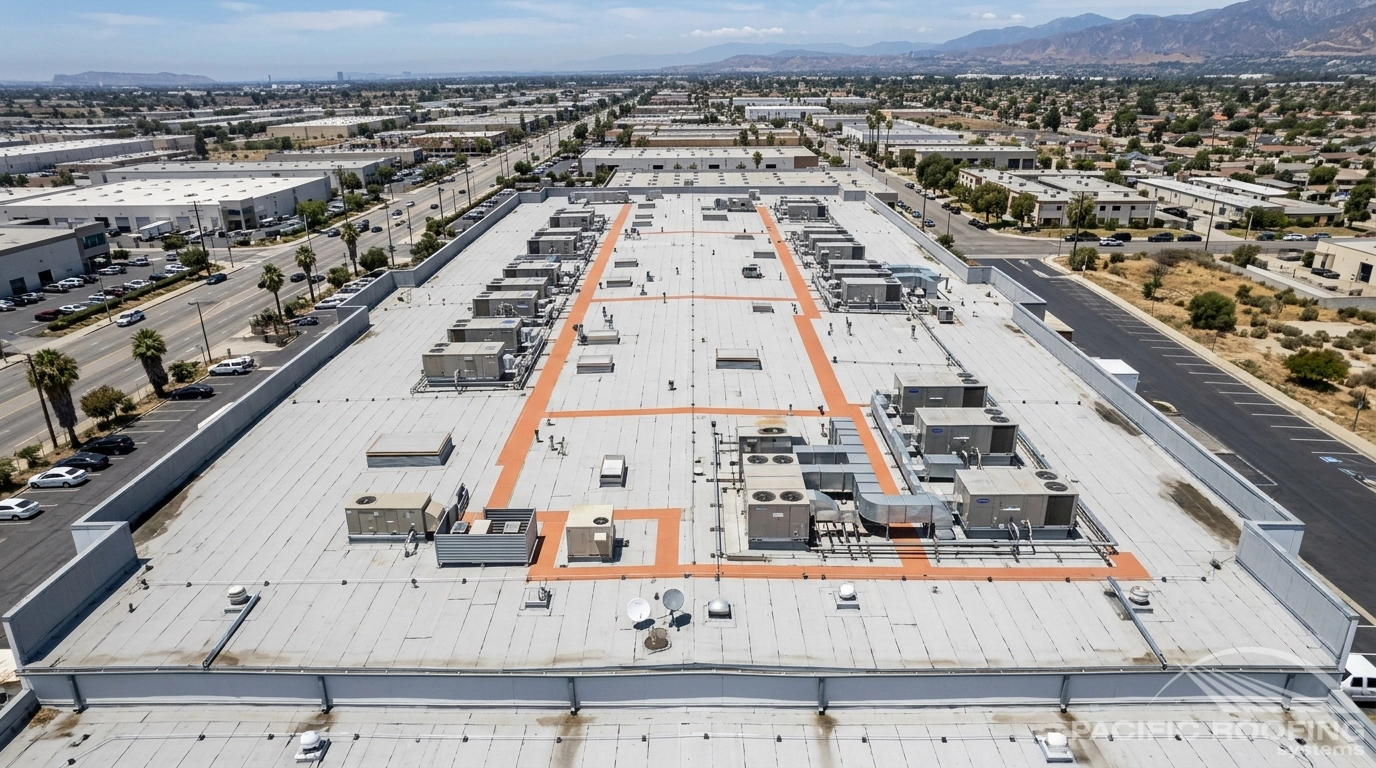
Pacific Roofing Systems uses drone inspections to document visible roof conditions and help identify areas that may require closer evaluation, maintenance, or repair. Depending on the property and roof system, our inspection may include review of:
- Roof field condition and visible membrane wear
- Ponding water patterns and drainage concerns
- Roof drains, scuppers, gutters, and downspouts
- HVAC curbs, equipment platforms, and roof-mounted units
- Pipe penetrations, vents, skylights, and flashing details
- Parapet walls, coping, edge metal, and transition areas
- Seams, laps, patches, coatings, and prior repair locations
- Storm, wind, debris, or impact-related damage
- Areas that may need hands-on verification or moisture evaluation
Thermal imaging is especially useful for large commercial roof areas where moisture intrusion may not be obvious from a standard visual inspection alone. While thermal data must be interpreted carefully and may require follow-up verification, it can help property managers prioritize maintenance, investigate recurring leak concerns, and make more informed repair decisions.
Drone Inspection Reports for Commercial Decision-Making
After the inspection, Pacific Roofing Systems can provide organized visual documentation to help property managers understand what was observed. Reports may include aerial photos, close-up images of visible concerns, roof area documentation, and practical recommendations based on the condition of the roof.
For commercial property teams, this documentation can be used to support:
- Annual roof maintenance planning
- Capital improvement budgeting
- Owner and board communication
- Vendor scope development
- Insurance-related documentation
- Pre-purchase or pre-sale due diligence
- Post-storm condition assessments
- Solar readiness evaluations
- Baseline roof condition records
Ideal Properties for Drone Roof Inspections
Drone roof inspections are especially useful for commercial and managed properties where access, safety, documentation, and efficiency matter. We regularly assist with:
- Industrial and warehouse buildings
- Office buildings and business parks
- Retail centers and shopping plazas
- Multifamily and HOA communities
- Medical and professional buildings
- Schools, churches, and institutional properties
- Commercial properties with multiple roof sections
- Buildings with limited or difficult roof access
For property managers and building owners, this step can help avoid costly surprises. Installing solar on a roof that is near the end of its service life, has unresolved drainage issues, or contains deferred maintenance can create future access and repair challenges. A roof condition review before solar installation helps support better long-term planning.
Drone Inspections vs. Standard Roof Inspections
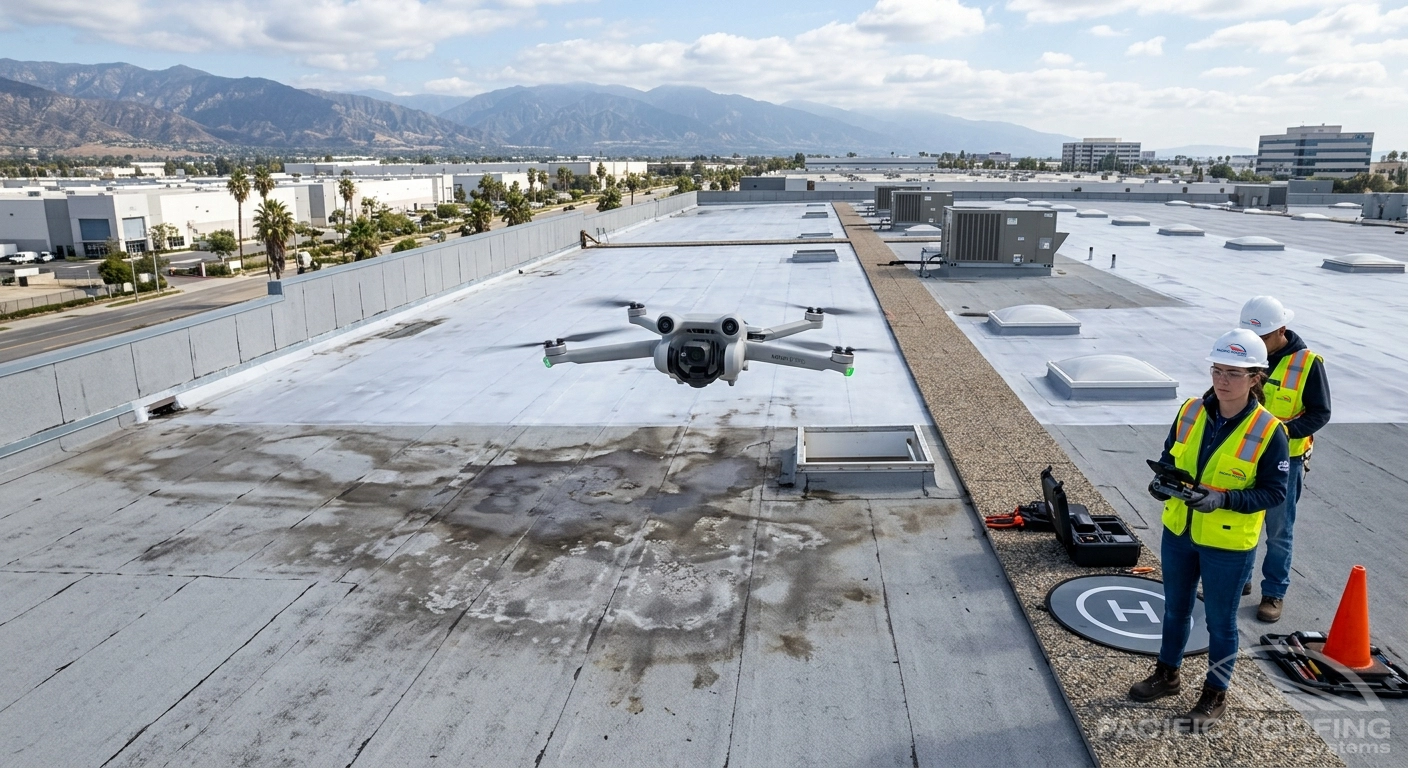
Drone inspections do not replace every type of hands-on roof evaluation. Some conditions still require physical inspection, core sampling, moisture verification, or direct access by a qualified roofing professional. However, drone imaging is an excellent first step for documenting conditions, identifying visible concerns, and determining where closer inspection may be needed.
Traditional Roof Inspection
- May require ladders and roof access coordination
- Can involve walking large roof areas
- May be more disruptive for tenants or occupants
- Can take longer on large commercial properties
- Provides limited aerial perspective
Drone-Assisted Roof Inspection
- Captures broad aerial views quickly
- Reduces unnecessary roof traffic
- Documents difficult-to-access areas
- Creates shareable visual records
- Helps prioritize maintenance and repair needs
Our process is straightforward:
- Property review: We discuss the building type, roof concerns, access limitations, recent leaks, maintenance history, and inspection goals.
- Drone imaging: We capture aerial photos and, when appropriate, thermal imagery of the roof surface and key details.
- Roof condition assessment: Our team reviews visible concerns, roof details, drainage conditions, and areas that may require follow-up.
- Documentation and recommendations: We provide organized findings that can help guide next steps, repairs, maintenance planning, or further evaluation.
Transparent Drone Roof Inspection Pricing
Drone roof inspections start at $375 and include a minimum of 15 images. Final pricing may vary based on property size, number of buildings, roof complexity, reporting needs, thermal imaging requirements, access conditions, and travel area.
For commercial properties, multi-building communities, portfolio inspections, or insurance-related documentation, Pacific Roofing Systems can provide a customized inspection scope based on your needs.
Important Drone Inspection Disclaimer
Pacific Roofing Systems provides aerial roof documentation and roofing-related observations. Drone imaging is not a substitute for survey-grade measurements, engineering analysis, destructive testing, laboratory moisture analysis, or work performed by a licensed land surveyor when those services are required. If exact property boundaries, engineering calculations, or survey-grade data are needed, the appropriate licensed professional should be retained.
Schedule a Commercial Drone Roof Inspection
If you manage a commercial property in Orange County or elsewhere in Southern California, a drone-assisted roof inspection can help you document conditions, reduce uncertainty, and make informed roofing decisions.
Contact Pacific Roofing Systems to schedule a drone roof inspection or request a proposal for a commercial property, HOA, industrial building, retail center, office complex, or managed portfolio.
Call Now: 949-495-4200 ·
The Only Estimate You Need
Accurate. Competitive. Transparent.

